 The mobile platform has allowed for quite a bit of experimentation. I’ve seen callbacks to the NES era, 16-bit, and more 32-bit remakes than you can shake a stick at (I’m looking at you Tomb Raider 1 and 2). But often times developers will put their own dose of charm into a game despite the fact that it doesn’t belong in a single era — and you get that feeling with Dojo Slash (Free) right from the get-go following a faux-DOS intro.
Dojo Slash is deliciously simple. It’s a one-button game where tapping slashes where you tap, and holding the screen will let you walk toward your finger. That’s basically it. You can constantly slash if you want to move as well, and eventually as you upgrade your lunges it’s probably best that you do it that way anyway — but the precision is there if you want it.
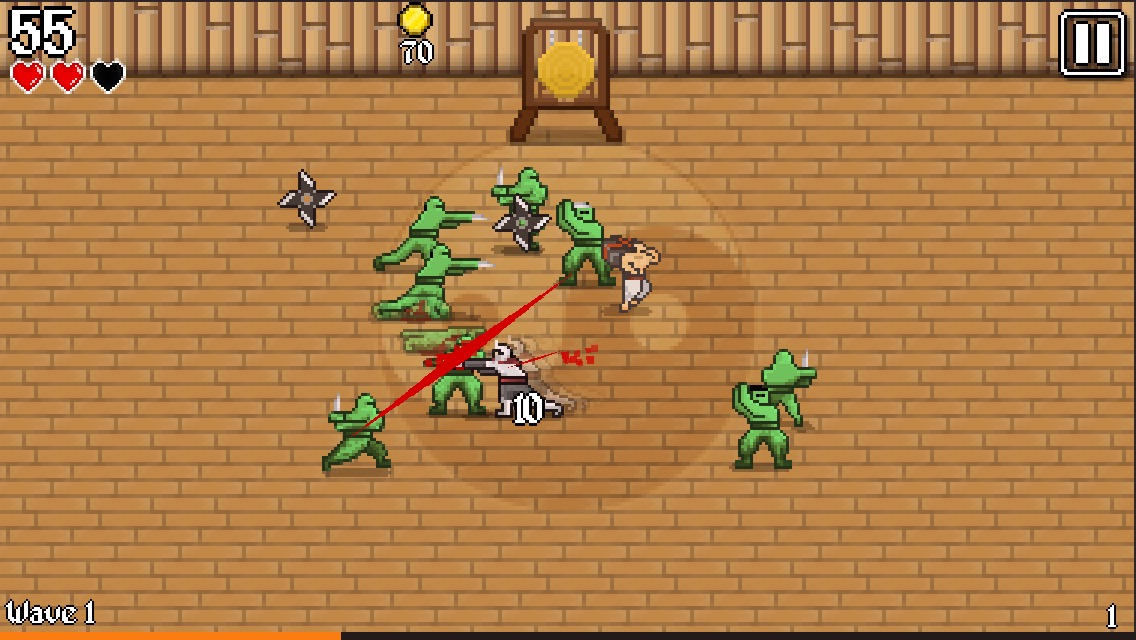
The slash-centric gameplay facilitates plenty of ninja kills as you take on enemies of all shapes and sizes. It’s basically a score-attack game where you last as long as you can, fighting wave after wave as they pour out across the screen. You’ll have to be quick to slash as each board can often fill up with foes very quickly, and there’s little time for idle movement.
This also ties into the combo element of Dojo, where constant kills will net you more points, and thus, experience. Every time you reach a certain experience goal you’ll level-up, which lets you choose from three random upgrades. Slash employs a pretty cool pixel art style, and each locale is changed for each round to spice things up.
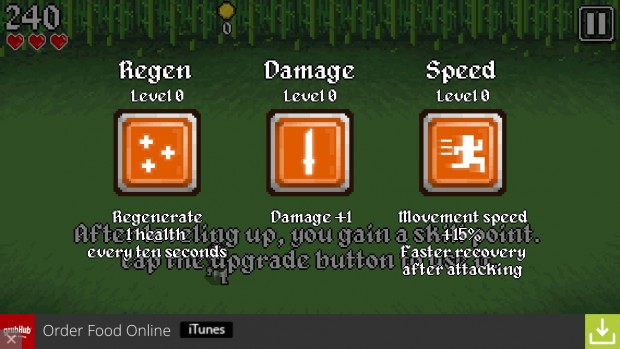
You don’t get to carry over any of these upgrades after death, so each game will feel a bit different as you cycle through various builds. There is an in-game currency system built in though that lets you upgrade your equipment over time — even if it’s a bit too grindy for my tastes. The grind is easier to take in though when you consider that there’s almost zero IAP involved. In fact, the only real upgrade is a $0.99 option to remove ads. Ads that aren’t even that bad to begin with mind you, and that particular IAP is buried heavily within the obtuse upgrade menu.
There’s also some complexity involved, as you can force enemy spawns by hitting a gong at the top of the board if you want. A Golden Axe-esque apprentice will additionally skitter about the battleground dropping items from a sack. It’s not groundbreaking, but the developers have done enough to make it the experience more interesting. And again, it all looks great with their smooth art style.
Dojo Slash is just plain fun, and for a nominal fee and hardly any IAP involved you can have a good old arcadey time. I wish there were a few more upgrade paths and perhaps a “quest mode" where you do keep your level-ups, but as it stands I’ve spent a decent amount of time slashing up people.


Indeed, very interesting points he has there.
Thanks for highlighting it as I would of missed it otherwise.
Cheers.
PS. Happy new year to you and the team, all the best.
That's not really the same in his comparison though, if you gave me the best golf clubs known to man I still wouldn't be good enough to play in the pros. If you gave me a super computer, the Asians would still crush me in Starcraft.
Now give someone 1000HP because they spent 500 dollars on Rage of Bahamut compared to someone who didn't spend any money and has 5HP, regardless of your deck the 1000HP will win.
Its not even the comparison he is making. You should probably read the quote, unless you are a pro golf/starcraft double threat.
I don't understand your response. I read the whole Brian Kibler article, and I think MagicMike's comment is completely relevant. I don't know if his comment is correct since I have no experience with Rage of Bahamut, but he's claiming that that's an example of a CCG where spending money can give you an insurmountable advantage over people who didn't spend as much. This is exactly the topic of Kibler's article. He was mainly discussing Magic and Hearthstone, but it seemed like he was also trying to generalize his comments to other similar games.
What I was getting at, is even if I spent a million dollars on golf clubs, and Tiger Woods had a stick he would beat me.Meaning that's not a pay to win...
Now let me stick with Rage of Bahamut since that's what I mentioned first, if you give me 500 dollars to spend on HP,, and you have 5 because you spent no dollars, it doesn't matter on your deck I'm going to beat you every day.
Basically think of it like this for those that play Call of Duty.
You have a Rocket Launcher I have a pistol. HOWEVER, bullets/rockets cost money. So if I spend 500 dollars on bullets and have 500 bullets, you spend nothing and have no rockets, I'm going to win.
Yeah, I know what you were getting at. He wasnt comparing you to Tiger Woods though, and thats the point you arent getting.
If you cloned Tiger Woods and gave him a $5 club and made him face off against Tiger Woods with a $5000 club, which one do you think would win?
That's pay to win.
Here is a quote directly from Kibler's article:
"Some games certainly *are* “Pay-to-Win”, strictly speaking, in which the more money a player spends, the more powerful they become and the more likely to succeed against players who have spent less. Most of them tend to be social or mobile games in which players can spend money to dramatically advance their progress, or acquire items or power-ups that significantly increase their ability to defeat other players. Many of them have little or no real strategy to speak of, but rather simply feed off of their users desire to get ahead of their friends or hold the top spots on leaderboards."
While it doesn't mention Rage of Bahamut by name, it seems that this paragraph covers games like it.
My understanding of his argument is that less that these activities are 'pay to win' but more that 'pay to win' is not a black and white proposition - many activities have elements where paying contributes (but not always guarantee) to their success, even those we perceive as highly skill based endeavors. Basically, there is a range of severity and circumstances where something is pay to win.
So certainly there are games where paying contributes much much more than others.
Of course, when we enter the realms of some of these pseudo card games, certainly there's a much stronger relationship between paying and winning. But these comparisons like you mention are always too extreme : the difference between spending $20 and $50, for example, can be made up through effort and active participation. When you get into the realms of the top rankers where everyone is spending ridiculous amounts of money, the money isn't always the most important anymore. It's often group communication and having strong active players at all times.
Even in your example, the relationship is not clear cut: owning a better set of clubs would certainly not allow you to beat Tiger Woods but they would certainly give you an advantage over a similarly skilled person... and in fact, going into a golf match with inferior equipment does put you at a significant disadvantage. Of course, when you compare a non-payer vs a 'whale', you're going to see a big, perhaps insurmountable difference. But you know, I'm sure if Tiger Woods stepped onto a PGA tee with a rock tied to a branch as a club (vs. all the high tech top line gear other pros use), we'd see an insurmountable difference too (which is effectively a non-payer vs. a whale).
He makes a good point, but only some freemium games use this model. Many others adopt a strategy that would look more like this:
A professional golfer has purchased top of the line clubs and some sweet golfing gear. He joins the PGA tour and finds after reaching the 3rd hole there is a giant gate preventing him to play on unless he pays $10,000. He begrudgingly pays the fee and continues on to the next hole- only to find the distance to the flag has tripled and the par for the hole halved! Using all of his talent he finally reaches the green when what do you know? He's hit another giant gate. As he reaches fo his wallet, he looks beyond the gate to see the green is made of lava, and surrounding it? Bears.
"Screw this, he says. I'm going to play XCOM."
If you read his article and not just the pull quote you'll see he addressed both kinds of games. Skill-based free to play games and time-based free to play games that use money as a means of skipping timer-centric advancement are two entirely different beasts and can't really be fairly compared.
I DID read the article and outside of the time vs money balance he doesn't really even go into timers, paywalls or the insane difficulty scales that many F2P games adopt to push gamers towards IAPs. In fact he kind of purposely avoids all that.
You're right that the two are different- but that doesn't mean one whole side of the industry should be entirely left out of the discussion. That'd be like having a retrospective of the Brazil 2014 World Cup and entirely skipping over the riots, protests and controversies that surrounded it. Sure, football is great but you have to address the larger context.
I found it bizarre that we use golf as a comparison to free to play games because honestly, if games used up money the way golf did, we'd all be complaining about it's aggressive monetization.
Consider:
- Golf requires a significant upfront investment in terms of equipment
- Golf is almost certainly pay to play as you need course memberships, green fees and even driving range balls cost money to practice
- Even paying a considerable amount, you will encounter other people who pay more and have an gear advantage over you
- No matter how much you pay, you still have to do a significant amount of grinding to skill up. The time and effort required to do so means people who do it full time have advantages to anyone who has a job or a social life
- Even if you get good, you pay a recurring fee to join the PGA and entry fees for tournaments
- In order to be competitive in these tournaments, you often have to continue to pay for better gear and recurring expenses for coaches, caddies, etc.
Essentially, golf is an expensive premium MMO with a recurring membership fee and endless amounts of semi-pay to win IAP and tons of grinding to stay competitive.
That's why I dont play golf :)
Interesting. So, launching off this article (and Brian's article), if I am a brand new player with 0 experience with collectible card games, have only an iPhone, and don't want to get involved with multiple games, is SolForge the way to go or should I wait for iPhone Hearthstone? I've sort of wanted to get into this for a while somehow, so reasons would be helpful.
I would like to know as well - thx!
Well, I mean, SolForge is a Kibler project so he's always going to tell you that you should play it. :)
Of course that would be combat monsters. (You won't have heard of that because excellent user reviews and cheap prices don't count for anything)
Solforge is very much a pay to win game in my experience. I'd wait for iPhone Heartstone.
Solforge is a fantastic lane based dueling game, with very tactical card play. You can have a lot of fun and good entertainment for time played without spending a dime. If you want to play an a1 grade deck the day after you dl the app, you would have to pay for currency to buy those cards. Same as magic tg. But that's not to your interest, because there is a thrill of earning your dailies getting free packs, and tweaking your deck to be better. Solforge rewards skilled play for sure. Solforge gets my ios game of the year.
Paywalls do exist though,and that in my opinion is what I consider pay to win..now I've been playing hearthstone since the beta and I have most(if not all) the cards,but i notice that,since the latest expansion how hard it is for newer players to enjoy the game...I'm only referring to hearthstone at this point....now when the game first launched players were getting cards at a decent rate,which was mainly due to winning 3 games in play mode or completing quests earning them gold..since the game started I've never spent a dime on it and I'm doing pretty good,but I can't help but see that no matter what time during the season it is,rank 20+ players with legendaries and naxx content which a lot of new players won't have!therefore drastically decreasing their chances of completing their win 3 games for gold thing and quests..what do you all think?
In a perfect world, matchmaking should address this. If you're a new player who just completed the Hearthstone tutorial with the basic cards and you're getting matched with players with full legendary net decks, that's a failure on Blizzard's part for matching you with them and not really the design of the game itself.
New players basically shouldn't be playing ranked games, as that's Hearthstone at a highly competitive level. Instead, they should be playing normals until they've got enough gold/dust to be competitive.
Anyway, it's kind of an interesting problem as the longer the game goes on and the more cards get added to the card pool the hill new players have to climb gets bigger. Magic addresses this with the standard format which aggressively rotates. No digital CCG is really old enough to need to solve this problem yet.
I agree! Hopefully they will fix this,cause I know I would hate starting out right now!!
In contrast, perhaps the new players are looking at the problem in the wrong way. In Trump's Teachings videos on his YouTube channel, Trump, a well-known Hearthstone player, shows off basic decks that are entirely free to play with zero money or gold spent on booster packs. These newb-friendly decks will at least get you up to rank twenty if not higher, if you are skilled enough. Not only that, but those same videos demonstrate the advanced skills needed to play Hearthstone competitively on the ladder with every single class, so that newbs can see the kinds of things they will need to practice in order to get good at the game. In short, education, not equipment, is how you bring new players into the game. You can have all the cards in Hearthstone and simply not be skilled enough to fight off someone who has advanced skills but zero cards from Booster Packs, and is only using a basic deck. For example, Ragnaros, a very powerful legendary card, can get wrecked by Whirlwind plus Execute, a 2 mana 2 card combo that uses only basic cards. Heck, Shadow Word: Death and Mind Control from the Priest class are two of the strongest cards in the game, and they are also basic cards! Are there bad basics? Yes. Are there bad legendaries, epics and rares? Yes. Everything has a counter, whether it be on a basic free-to-play level or an advanced, pay-to-win level. Plus, the random nature of the deck shuffling and drawing means that even if you have all the cards and bling out your decks, you may draw these supposedly uber cards at exactly the wrong time! Case in point: the Legendaries deck showcased on TotalBiscuit's channel, in the video series Lord of the Legendaries. The Legendaries deck is the very definition of "pay-to-win" because it included almost every single Legendary card available at the time... except it's one of the worst possible decks you can build. Everything has too high a mana cost, which means that the early game is overtaken easily by fast opponents, crushing his deck consistently. He had to play the deck over several hour-long videos just to get the damn thing to Rank 20, and that ended up being the ceiling that he could take the deck to. If I remember right, he couldn't take it much higher than that. Granted, this is just one example, but it demonstrates my point: advanced skills are more important to master than having every single card available. TotalBiscuit simply isn't that good a Hearthstone player despite having paid money for all the Legendary cards, whereas someone like Trump or Hafu have played Hearthstone to the point where the advanced tactics the game has are second nature to them. They got to their level of skill by playing the game, NOT by buying every card and running on autopilot. Do options open up the more cards you have? Of course! And you can get those cards by being patient, playing the game, and doing your best to have fun! Forgive me if this comment comes off as defensive; Hearthstone is one of those games that I enjoyed playing for free, and have enjoyed paying for some of the cards as I got better at it. I paid attention to the game's design as I played, and I consistently have fun, even at the lower ranks. It helps that I watched Trump's videos and considered areas that I could improve my technique. There is an effective way to play the game, if you're willing to learn it. No amount of expansion content or advanced card packs can make up for that.
My problem with free to play games is not that they eventually require some money, rather it's that to play these games to the full in ways where you are not frustrated constantly by barriers and timers that were intended to be frustrating is to constantly pay. The amount you end up paying can be huge. I play Simpsons Tapped Out and if I wanted to I could spend £100 in donuts to speed up today's tasks and buy a tiny fraction of the premium buildings. By tomorrow I could easily do the same again. There is no point where I have paid my dues and can get on with. Frustration free game without more cost. A game like bloodbowl however seems fairer. I buy the game with a low investment, buy the extra teams as I get into the game and want more real content and at some point I have bought the whole game. I don't pay to remove intentionally frustrating elements, I pay to get more of the fun content.
Or try combat monsters. A F2P game with none of those blockers.
So over this type of game. Mobile gaming really has gone to the wolves. So while the wolves feed, I have been enjoying computer games on my laptop with the one time purchase cost...better graphics, better and deeper gameplay...not the shallow repetitiveness of games like the one described here.
The trick is that his analogy has been written in a manner that supports his opinion. I could just as easily say Pay-To-Win games are like people competing in a marathon race, one runs the race while another spends cash to use a bicycle, and yet another uses a car. Bottomline, these types of games are designed so that if you want to win more often you spend cash. While other games your win rate depends MUCH more on the person's skill/abilities than how much cash they have.
Buying a high end PC isn't going make the player understand StarCraft tactics any better. Likewise million dollar golf clubs in the hands of a non-golfer isn't going give a proper swing technique.